

Scrum Aspects
Overview
The five Scrum aspects shape how a project is organized, justified, controlled, and improved — from first Sprint to final release.
5
Core Aspects
3
Scrum Roles
100%
SBOK Aligned
∞
Adaptability
Five areas. One cohesive
delivery framework.
Scrum aspects are the important areas that must be actively managed throughout every project — from team structure to risk response.

Scrum aspects are the important areas that must be addressed and managed throughout a Scrum project. Together, they help teams align the project structure, business value, quality expectations, change tolerance, and risk response — creating a more complete foundation for successful delivery.
Organization
The organization aspect focuses on the people, roles, and structure required to support Scrum delivery successfully.

Understanding defined roles and responsibilities is essential in Scrum. This aspect focuses on how the project is organized, including the structure of the Scrum Team and the distinction between core and non-core roles.
SCRUMstudy describes three core roles: the Product Owner, who is responsible for maximizing business value and representing the voice of the customer; the Scrum Master, who facilitates the process and removes impediments; and the Scrum Team, which estimates work and creates the project deliverables.
It also highlights non-core roles such as business stakeholders, supporting services, vendors, and the optional Scrum Guidance Body. These roles may not be involved continuously, but they can strongly influence project success.
 What it covers
- Core and non-core Scrum roles
- Clear responsibilities and accountability
- Team structure for projects, programs, and portfolios
 Why it matters
- Creates clarity in decision-making and delivery
- Helps teams collaborate with the right stakeholders
- Builds a stronger foundation for effective execution
Business Justification
Business Justification explains why the project should be undertaken and why it should continue to receive support and investment.
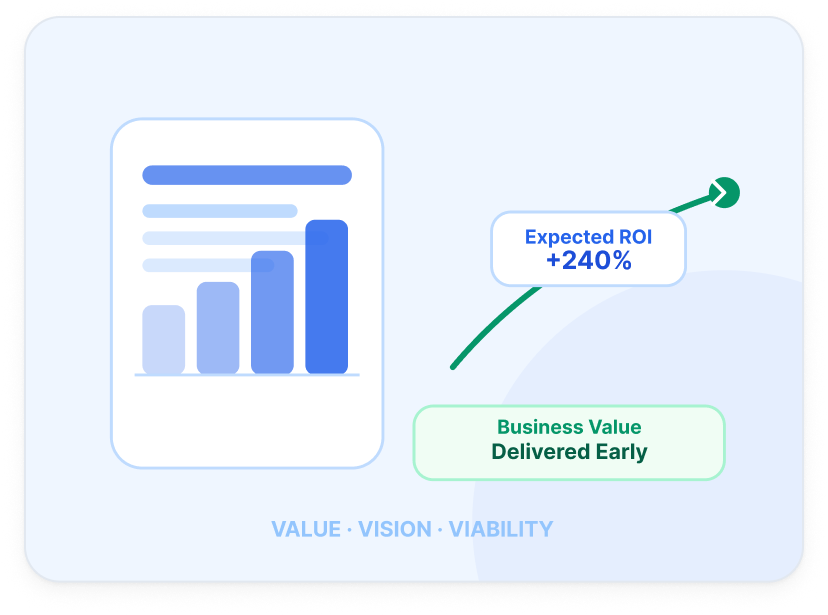
SCRUMstudy emphasizes that a proper business justification and a viable Project Vision Statement should exist before a project begins. This helps decision-makers understand the business need, evaluate whether the effort is worthwhile, and guide the Product Owner in building a prioritized backlog.
In Scrum, business justification is closely tied to value-driven delivery. Because projects always involve uncertainty, Scrum encourages early delivery of results so stakeholders can see value sooner, validate the direction, and potentially reinvest with greater confidence.
Business justification is not only an early-stage activity. It should be checked throughout the project lifecycle to confirm that the initiative still makes sense as priorities, constraints, and expectations evolve.
 What it focuses on
- Ensures the project is needed
- Expected business value and outcomes
- Continued relevance across the lifecycle
 Why it matters
- Supports smarter investment decisions
- Keeps work aligned with business priorities
- Helps teams deliver value early and often
Quality
In Scrum, quality is tied to meeting acceptance criteria and achieving the business value expected by the customer.
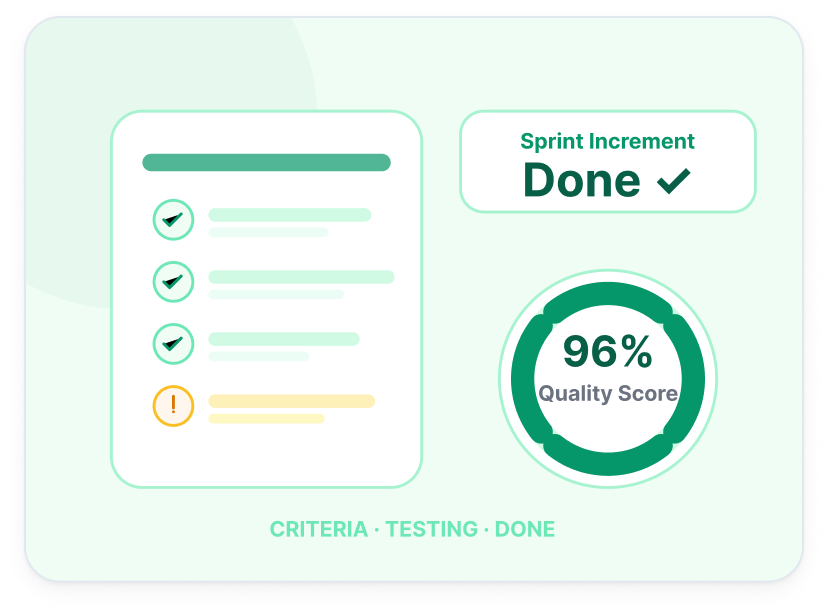
SCRUMstudy defines quality as the ability of the completed product or deliverables to meet the acceptance criteria and deliver the business value expected by the customer. Scrum approaches quality through continuous improvement rather than leaving it to the end of the project.
Because work is completed in increments during Sprints, defects and gaps can be discovered earlier. Quality-related tasks such as development, testing, and documentation are completed within the same Sprint, helping quality become part of the work instead of a separate late-stage checkpoint.
Regular discussions between the Scrum Core Team and business stakeholders, along with reviewing actual product increments, reduce the gap between customer expectations and the deliverables being produced.
 What supports quality
- Acceptance criteria and stakeholder feedback
- Incremental delivery and repetitive testing
- Continuous backlog updates as needs evolve
 Why it matters
- Finds issues earlier in the lifecycle
- Makes quality part of every Sprint
- Improves alignment with customer expectations
Change
Scrum recognizes that change is inevitable and is designed to embrace changing requirements rather than resist them.
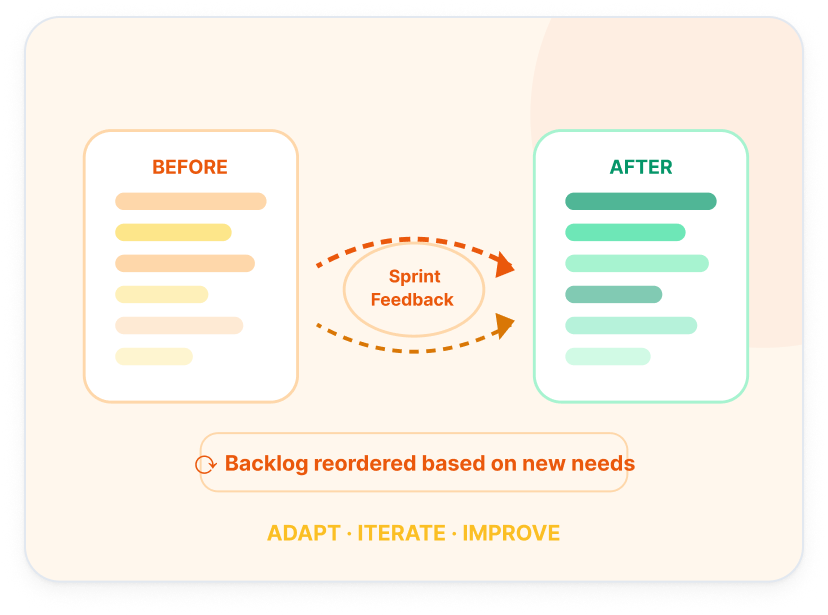
Every project is exposed to change, regardless of the method used. SCRUMstudy stresses that Scrum development processes are designed to embrace change, helping organizations maximize the benefits that come from new information while minimizing negative impacts.
Scrum acknowledges that business stakeholders often change their minds about what they want and need, and that it is very difficult to define all requirements during project initiation. Short, iterative Sprints allow teams to incorporate feedback frequently and adjust earlier.
Instead of treating change as an exception, Scrum treats it as something normal. That mindset supports responsiveness, better stakeholder engagement, and a stronger match between the evolving need and the product being delivered.
 How Scrum supports change
- Short Sprints and frequent feedback loops
- Regular review of increments with stakeholders
- Backlog refinement as needs evolve
 Why it matters
- Reduces the cost of late discovery
- Improves fit between product and expectations
- Helps teams adapt without losing momentum
Risk
Risk in Scrum includes both threats and opportunities, and it should be managed proactively throughout the project lifecycle.
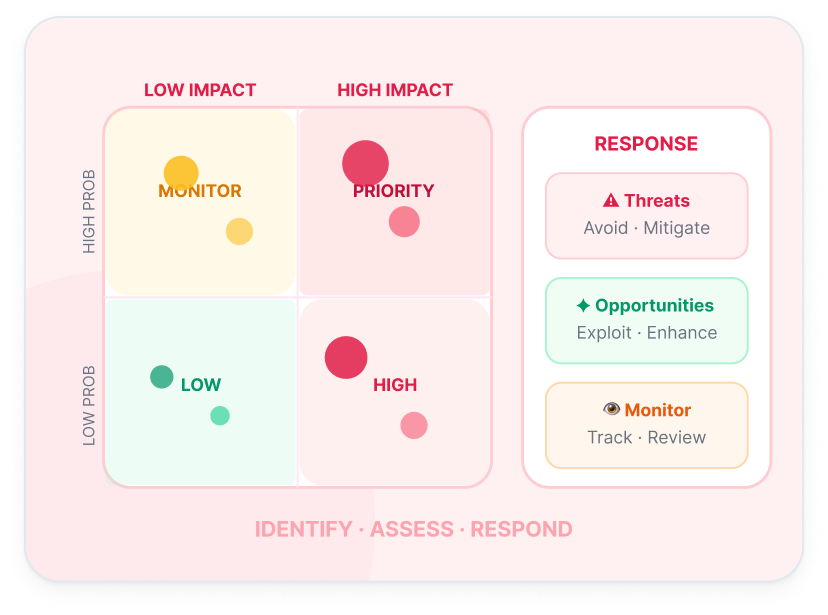
SCRUMstudy defines risk as an uncertain event or set of events that can affect project objectives and contribute either to success or failure. Positive risks are opportunities, while negative risks are threats. In Scrum, risk management should begin early and continue iteratively.
Risks should be identified, assessed, and responded to based on two main factors: the probability of occurrence and the likely impact. High-probability, high-impact risks need greater attention than lower-priority risks.
Scrum’s incremental approach helps surface risks earlier because work is delivered in smaller pieces, feedback arrives sooner, and teams can respond before issues grow larger.
 What risk management involves
- Identifying threats and opportunities
- Assessing probability and impact
- Planning responses and monitoring continuously
 Why it matters
- Encourages proactive decision-making
- Helps teams act before risks escalate
- Improves confidence in project outcomes
Build a stronger understanding of Scrum with PMstudy
Learning the Scrum aspects helps professionals see how Scrum projects are organized, governed, and improved in real environments. Explore PMstudy's Scrum learning options to strengthen both your practical understanding and your certification readiness.
