

Scrum for Enterprise
Scrum can scale beyond individual teams and projects to support enterprise- level delivery. At this level, organizations may be coordinating many Scrum Teams across multiple projects, programs, or portfolios while still using Scrum to maintain alignment, prioritization, and value-driven delivery.
 Explore the SBOK Guide
Scrum can support coordinated delivery across related initiatives
Scrum can help prioritize and align broader organizational work
Teams or people may be involved across enterprise delivery
Enterprise Scrum at a Glance
At the enterprise level, Scrum expands from team execution to coordinated program and portfolio management.
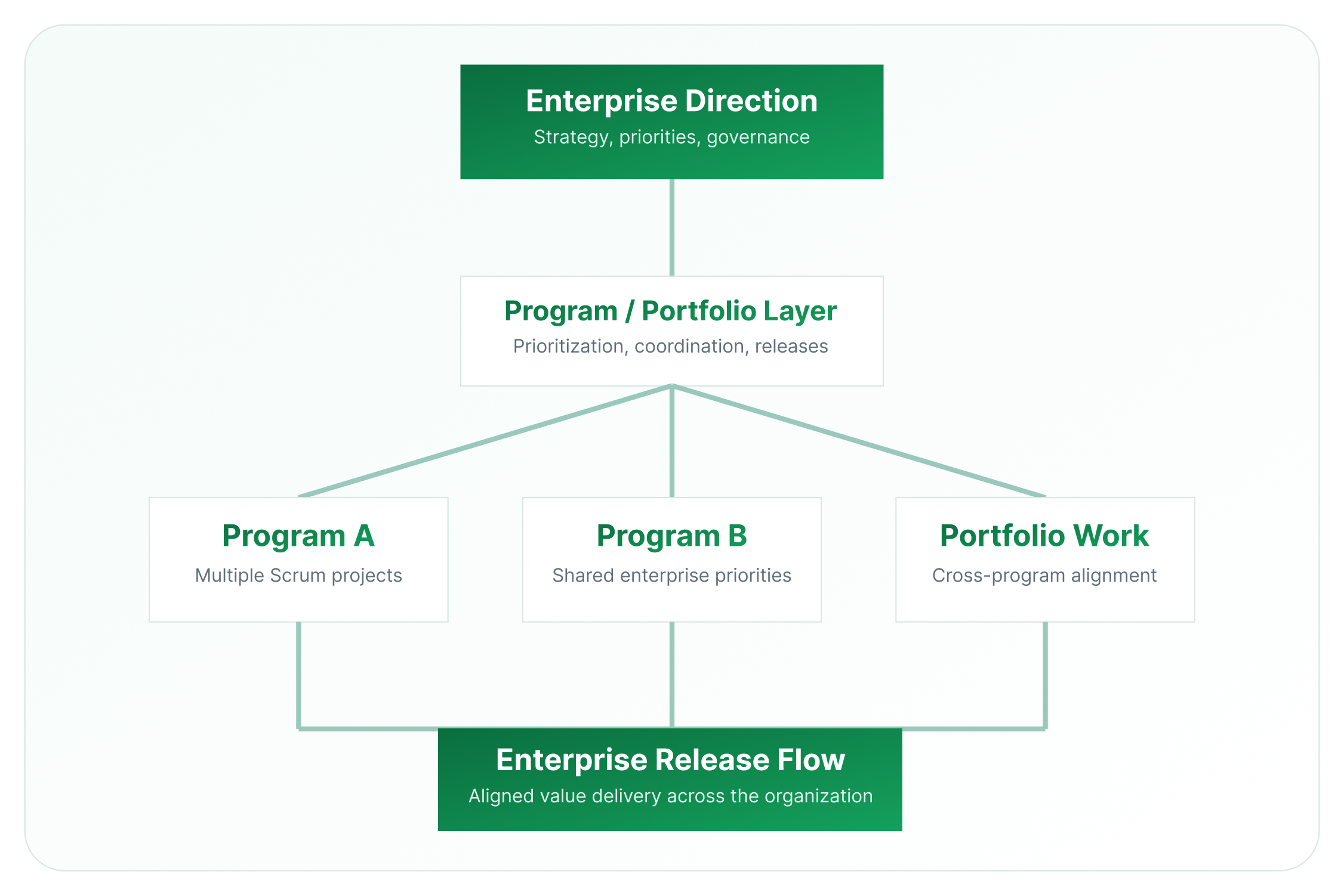
This view shows how enterprise Scrum adds coordination and prioritization layers above project-level delivery.
Enterprise Scrum vs. a single Scrum project
A single Scrum project focuses on one team or a small number of teams delivering a specific product or outcome. Enterprise Scrum expands that model to coordinate many projects, programs, and portfolios across the organization.

Single Scrum project
- Limited number of teams and stakeholders
- Project-level backlog and release focus
- Simpler communication and decision flow
- Less coordination across initiatives

Enterprise Scrum
- Many teams may be working across several projects
- Program and portfolio prioritization become important
- Coordination expands beyond one project boundary
- Additional governance and release processes are needed
What changes when Scrum scales to the enterprise
Core Scrum processes still apply at the project level, but enterprise delivery adds more complexity. This requires additional structures to coordinate priorities, teams, releases, and guidance across the organization.
Broader coordination
Enterprise Scrum coordinates work across multiple projects and programs rather than focusing on one team stream alone.
Portfolio-level prioritization
Frequent reviews and stakeholder interaction help teams validate whether the work being delivered still matches current business needs.
Guidance and governance
Enterprise delivery often benefits from a Scrum Guidance Body or similar structure to support standards and alignment.
Release synchronization
Multiple streams of work may need to converge into coordinated program or portfolio releases.
Additional enterprise-level processes
Scaling Scrum for the enterprise can require processes that are not needed in a typical project-level implementation.
Program and portfolio processes
- Create/Update Program or Portfolio Teams
- Create/Update Program or Portfolio Components
- Review and Update Scrum Guidance Body
- Create/Refine Prioritized Program or Portfolio Backlog
- Create/Update Program or Portfolio Releases
- Retrospect Program or Portfolio Releases

Why enterprise Scrum matters
Enterprise Scrum helps organizations preserve the adaptability of Scrum while coordinating work at a much larger scale. It supports aligned priorities, clearer release planning, and a stronger connection between strategy and delivery.
What it helps organizations do
- Align multiple teams and initiatives
- Prioritize work across programs and portfolios
- Improve coordination between delivery streams
- Support broader release planning and visibility
Why it is valuable
- Connects strategic direction with delivery execution
- Improves transparency across the enterprise
- Supports better decision-making at scale
- Keeps Scrum relevant in complex organizations
Explore enterprise-scale Scrum with PMstudy
Scrum can extend well beyond a single project when the right coordination, prioritization, and release structures are in place. Explore PMstudy’s Scrum learning options to strengthen your understanding of how Scrum works across programs and portfolios.
