

Master the Scrum
Principles that drive
results
Scrum is built on six foundational principles that guide how teams plan, collaborate, prioritize, and deliver work � helping you stay adaptive, transparent, and focused on value.

Scrum principles are the core guidelines for applying the Scrum framework. They help teams make better decisions, respond to change, work collaboratively, and deliver useful outcomes in a structured yet flexible way.
The six principles of Scrum
Each principle supports a different part of how Scrum teams operate — together they form a connected way of working that encourages learning, ownership, and continuous delivery.
Empirical Process Control
Self-Organization
Collaboration
Value-Based Prioritization
Time-Boxing
Iterative Development
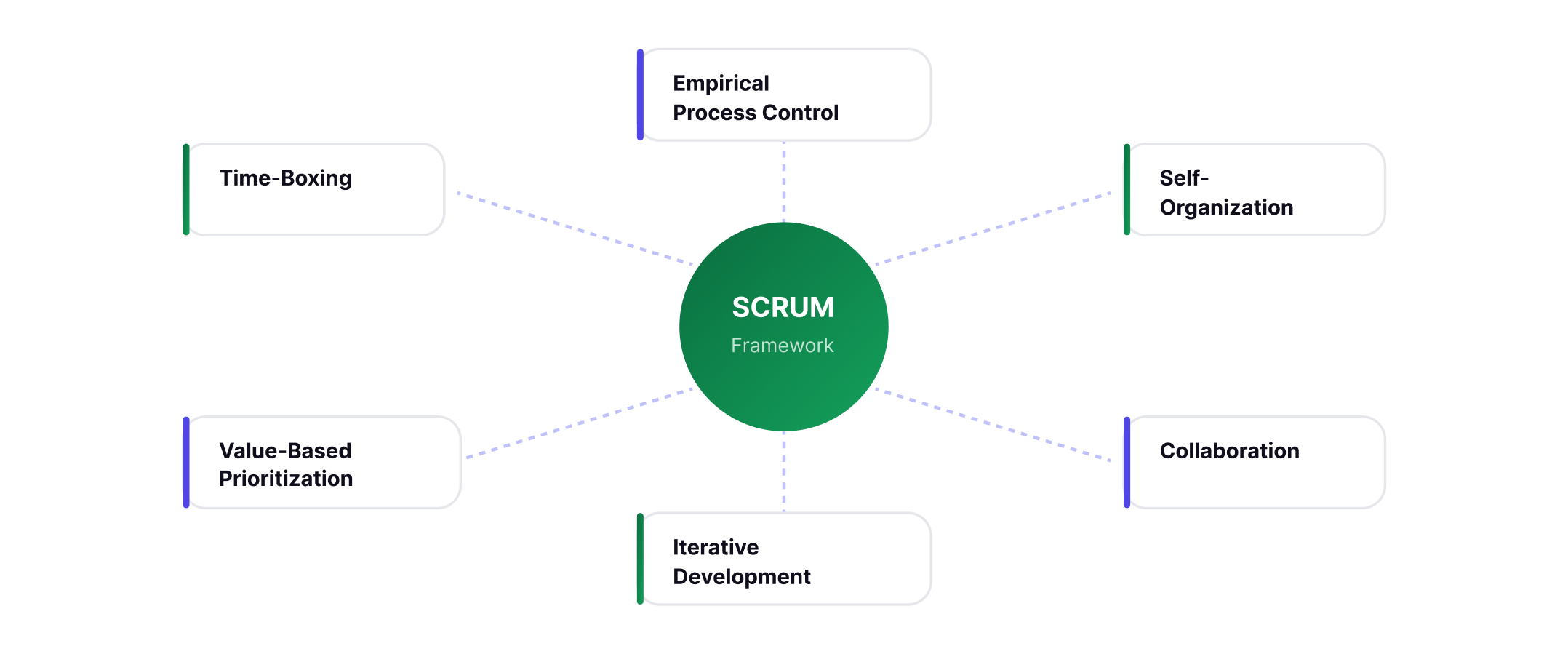
The six Scrum principles work together — each reinforcing the others in an interconnected system.
Empirical Process Control
Scrum relies on observation, learning, and adjustment instead of assuming that everything can be fully predicted upfront.

Empirical Process Control is one of the most important ideas behind Scrum. It recognizes that many projects involve uncertainty, evolving requirements, and changing stakeholder needs. In those environments, teams cannot rely only on detailed upfront planning — they need to learn from real work as it happens.
This principle is built on three connected ideas: transparency, inspection, and adaptation. Transparency helps everyone see the current state of the work. Inspection allows teams and stakeholders to review progress regularly. Adaptation makes it possible to adjust direction, plans, or priorities when needed.
What it emphasizes
- Work should be visible and understandable
- Progress should be reviewed regularly
- Teams should adjust based on what they learn
Why it matters
- Reduces the risk of staying on the wrong path
- Supports faster learning in complex work
- Helps teams make decisions using evidence
In practice: Sprint Reviews and Retrospectives are good examples of empirical thinking in Scrum. Teams look at results, gather feedback, and refine how they work in the next cycle.
Self-Organization
Scrum teams are expected to organize their own work, take ownership, and decide how best to achieve agreed outcomes.

Self-Organization means that the team does not wait for every decision to be made externally. Team members collaborate to decide how work should be approached, who should take on which responsibilities, and how to solve problems as they arise.
This principle reflects the idea that people are more engaged and effective when they have ownership over their work. It also aligns with servant leadership, where leaders support the team’s success rather than controlling every detail of execution.
What it encourages
- Shared ownership of goals and outcomes
- Greater motivation and team buy-in
- Faster decisions at the team level
Why it matters
- Supports accountability inside the team
- Creates room for creativity and problem solving
- Builds confidence and stronger collaboration
In practice: During Sprint Planning, the team decides how much work it can take on and how that work will be completed, rather than having a detailed plan imposed from outside.
Collaboration
Scrum depends on people working together closely, sharing information openly, and aligning on goals, progress, and decisions.

Collaboration in Scrum is more than communication alone. It requires people to work together with a shared purpose, contribute to the same outcome, and remain aware of how their work connects with the work of others.
SCRUMstudy describes collaboration through three key ideas: awareness, articulation, and appropriation. Teams need awareness of one another’s work, the ability to divide and reintegrate tasks effectively, and the flexibility to adapt tools and approaches to fit the team’s actual situation.
Key dimensions
- Awareness of what others are doing
- Clear coordination of shared work
- Ability to adapt tools and methods as needed
Benefits
- Improves alignment across roles and stakeholders
- Reduces misunderstandings and rework
- Supports better problem solving as a team
In practice: Daily Scrums encourage continuous coordination by helping team members stay aware of progress, blockers, and immediate next steps.
Value-Based Prioritization
Scrum focuses on delivering the most valuable work first so teams create meaningful outcomes early and continuously.

Value-Based Prioritization helps ensure that teams are not simply staying busy, but are working on what matters most. Instead of treating all requirements as equal, Scrum encourages ordering work in a way that reflects business importance and customer value.
SCRUMstudy highlights three important considerations during prioritization: value, risk or uncertainty, and dependencies. This helps teams sequence work in a way that balances impact, complexity, and practical constraints.
What guides prioritization
- Business or customer value
- Risk and uncertainty
- Dependencies between items
Why it matters
- Supports early delivery of useful outcomes
- Improves return on effort and investment
- Keeps the backlog aligned with real priorities
In practice: The Product Owner orders the Product Backlog so the team can deliver higher-value items sooner instead of waiting until the end of a project.
Time-Boxing
Scrum uses fixed time limits to create focus, improve predictability, and keep work moving at a sustainable pace.

Time-Boxing means that activities are performed within a defined maximum duration. Instead of letting work or meetings expand endlessly, Scrum introduces fixed boundaries for important events such as Sprints, Daily Scrums, Sprint Planning, Sprint Review, and Sprint Retrospective.
This principle improves discipline and decision-making. It encourages teams to focus on the most important work, avoid unnecessary delays, and create a cadence that stakeholders can rely on.
What it supports
- Focused discussions and execution
- Better planning rhythm and team cadence
- Reduced scope creep and delay
Why it matters
- Creates clearer expectations
- Improves scheduling and predictability
- Keeps teams moving toward delivery goals
In practice: A Sprint may last one to six weeks, while the Daily Scrum is kept short and focused so coordination happens without consuming excessive time.
Iterative Development
Scrum promotes building and improving the product through repeated cycles, learning from each increment along the way.

Iterative Development means that work is not treated as one large, single delivery effort. Instead, the product evolves through a series of smaller increments. Each iteration creates an opportunity to review what has been delivered, gather feedback, and refine the next step.
This principle reduces risk because teams do not wait until the very end to test assumptions. It also supports continuous learning, which is especially useful in environments where needs change or clarity improves over time.
What it encourages
- Frequent delivery of usable progress
- Continuous feedback and improvement
- Refinement based on real experience
Why it matters
- Reduces the risk of late-stage surprises
- Improves adaptability as needs evolve
- Helps teams learn faster and deliver better
In practice: At the end of each Sprint, the team produces an increment that can be reviewed, validated, and used to guide future backlog decisions.
How these principles support Scrum delivery
Together, these principles shape how Scrum teams work — each one reinforcing the others in a connected system.

Learn from Reality
Empirical thinking helps teams learn from real work instead of assumptions, enabling better decisions at every stage.

Strengthen Execution
Self-organization and collaboration create teams that take ownership, solve problems, and align around shared outcomes.

Stay Focused on Value
Value-based prioritization keeps work aligned to what matters most, ensuring teams deliver impact with every Sprint.

Maintain Rhythm
Time-boxing provides the discipline and structure that keeps teams moving forward without unnecessary delays.

Continuously Improve
Iterative development supports continuous improvement and delivery — reducing risk while building momentum.

Build the Foundation
Mastering these six principles gives any practitioner the bedrock needed to apply Scrum with confidence and consistency.
Build a stronger Scrum foundation with PMstudy
Understanding Scrum principles is an important step toward applying Scrum with confidence. Explore PMstudy's Scrum learning options to deepen your knowledge and connect core principles with real project delivery.
